

The Noise
If you tune into the financial news lately, you’re probably hearing a lot of panic. And to be fair, the raw numbers do look a bit intimidating at first glance. Between late 2024 and early 2026, foreign investors packed up and pulled about ₹4.4 lakh crore out of the Indian stock market. In fiscal year 2026 alone, we saw around ₹1.74 lakh crore head for the exits.
In the past, this kind of money leaving—mostly driven by shifting US interest rates and the global trend toward AI and semiconductors—would have weighed heavily on our markets. It usually meant a long, painful downturn. The chatter right now suggests India is losing its edge and that we’re vulnerable without that foreign money.
The Signal
But let’s zoom out and look at the actual data. Beneath all that noise, there’s a pretty remarkable shift happening. While foreign money was leaving, Indian households quietly stepped up.
Thanks to a change in how we save and invest, domestic funds completely absorbed the shock. They did this by putting roughly ₹12.2 lakh crore into our equity markets during that exact same time.
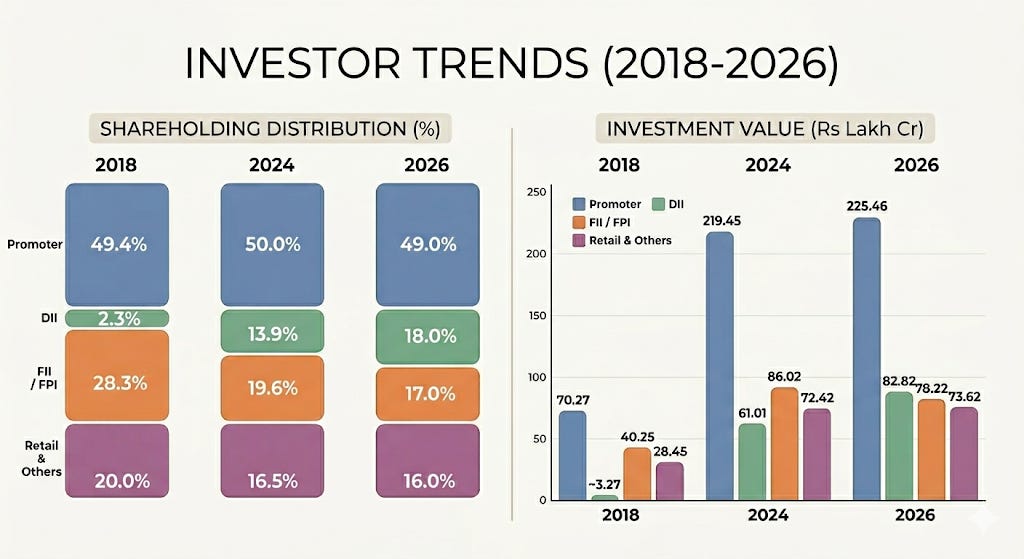
The proof is right there in the ownership numbers. Think back to 2018 or 2019: foreign investors held about 28.3% of Indian equities. Fast forward to today, and that footprint has shrunk to 17.0%. Meanwhile, domestic institutions have grown their share from just 2.3% in 2018 to 18.0% today. For the first time, local funds own more of the market than foreign ones do.
The real driver here? The humble SIP (DIIs). By April 2026, everyday folks were consistently putting over ₹31,115 crore into the market every single month. Unlike foreign money that tends to chase global trends, this local capital sticks around. People invest month after month, rain or shine. In fact, by 2025, for every rupee a foreign institution took out, our local mutual funds and insurance companies reinvested ₹2.57 right back in. We just aren’t relying on outside capital the way we used to. The Indian market is firmly in Indian hands.
The Value Investor’s Lens
So, what does this mean for us as patient, long-term investors? Our job is simply to notice how this steady flow of local money is affecting stock prices and creating interesting opportunities. Right now, we’re looking at a “barbell” market. It’s basically a tug-of-war that’s causing very different valuations on opposite ends of the spectrum.
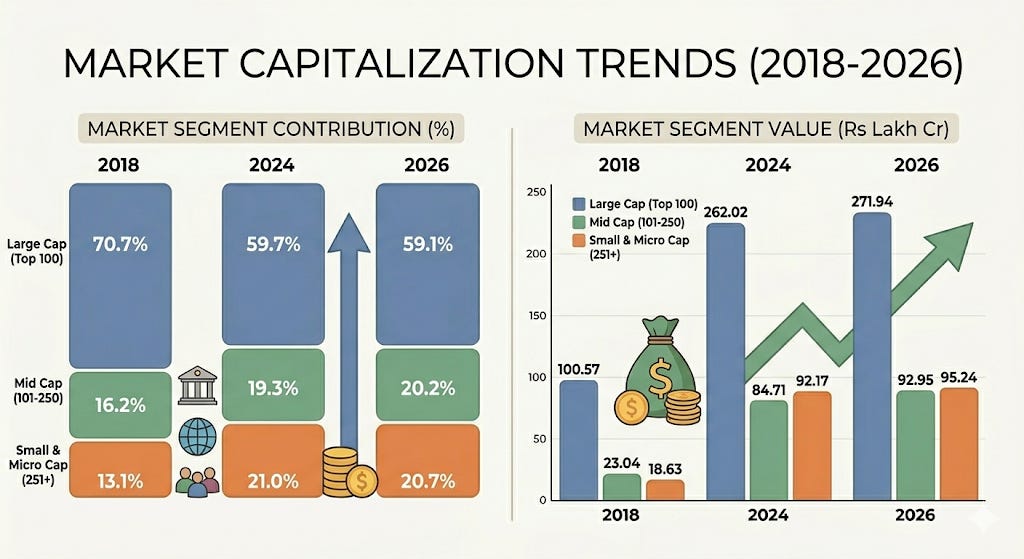
The Small-Cap Squeeze: With so much cash coming in, domestic funds and retail investors have been looking for growth in the smallest companies on the market. Back in 2018, small and micro-caps made up just 13.1% of the total market. By 2026, that share grew to 20.7%. This extra money has pushed mid and small-cap stocks to trade at premiums of 13% and 21% above their five-year historical averages. Folks buying into these smaller companies right now are taking on a fair bit of hidden risk. (It’s worth remembering that the Nifty Microcap 250 index has historically seen drops as deep as 82.3%). When things feel stable for a long time, it’s easy to get comfortable and forget about the risks involved.
The Large-Cap Opportunity: On the flip side, the steady selling by foreign investors has weighed down the prices of some of India’s biggest, most established companies. In 2018, large caps made up over 70% of the market. Today, that’s shrunk to 59.1%. Because of this shift, large caps are actually sitting at about a 9% discount compared to their five-year averages. Solid financial institutions like HDFC Bank, ICICI Bank, and Bajaj Finance are still expecting healthy double-digit growth. But lately, exiting foreign funds have essentially used them as ATMs. It’s not because the businesses are struggling; it’s mostly just market mechanics. Think of it like local real estate: people are bidding up small, unproven plots on the outskirts of town, while the prime, income-generating downtown properties are sitting on the discount rack just because a foreign owner needed to sell quickly.
The “FII proof” moats: Finally, we’re noticing a group of companies that are fairly insulated from these foreign exits. Businesses supported by strong government policies—like major defense players, for example—are being bought up steadily by local institutions. Plus, the government’s recent move to raise the tax on derivatives (STT) to 0.15% is cooling down hyper-active day trading. It’s a practical step. It gently nudges retail money away from short-term speculation and encourages folks to invest in real businesses for the long haul. Ultimately, that just strengthens the foundation of our local market.
The Bottom Line
The direction of the Indian stock market is now largely in the hands of the Indian household. At the end of the day, building lasting wealth isn’t about following the crowd into overpriced, smaller stocks. It’s about having the patience to quietly pick up high-quality businesses when the rest of the world happens to be looking the other way.
Join the Hunt
The market is noisy. Your inbox shouldn’t be.
By subscribing to Budget Tiger, you’re making a commitment to rational, owner-oriented investing. Here is my commitment to you:
One email a week: Delivered every Sunday at 8 AM.
100% Signal: Deep research powered by AI, vetted by human judgment. No spam, no filler.
Always Free.
You’ll get one email a week from me. It will cover:
The Noise: What the AI hype-filter caught (and why to ignore it).
The Signal: The fundamental truth about the cash flows and moats.
The Verdict: A qualitative deep dive, not a quantitative score.
Leave the noise behind. Enter your email below to receive next week’s edition of Budget Tiger in your inbox.
Good morning Sir, Hope all is well with you. No post last Sunday as well as today hence checking . Thanks