

The Small Giant of Indian Rail: How a 40-Year-Old Spring Maker Multiplied Its Content per Coach (at 50% ROCE)
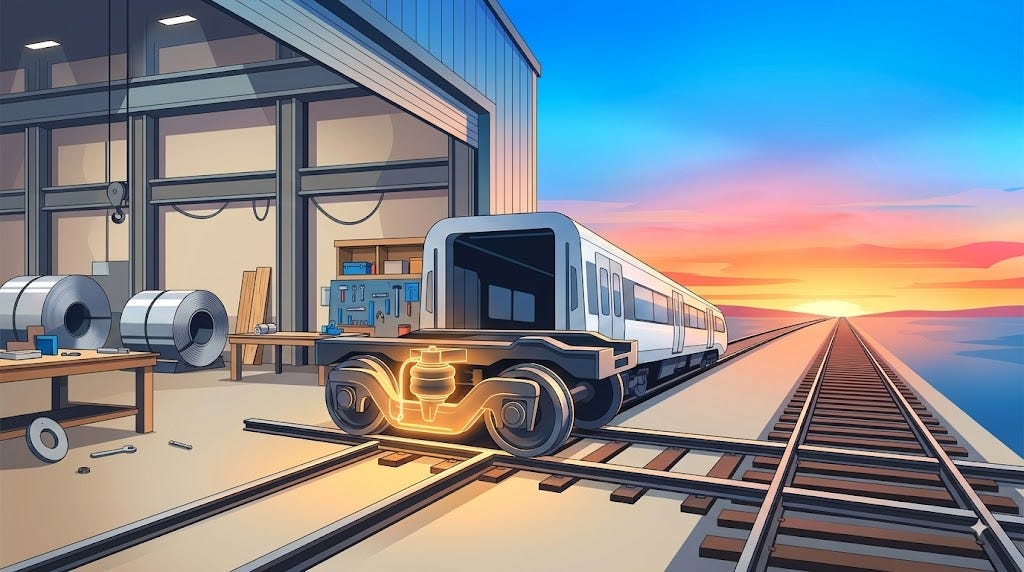
The Noise
Whenever quarterly earnings season rolls in, the stock market develops an acute case of short-sightedness.
When Frontier Springs published its Q1 FY27 results, headline-watchers hit the panic button: while revenue crawled up 4.1% year-over-year to ₹78.46 crore, Profit After Tax (PAT) tumbled 18.6% to ₹12.01 crore. For momentum traders operating on a 90-day horizon, a double-digit drop in quarterly profit is usually a cue to exit.
The consensus chatter quickly concluded that the growth engine had derailed. But if you look beneath the surface, that margin dip was driven by a single, temporary mechanical factor: raw material price inflation in specialized Chrome-Molybdenum steel (Grades 52Cr4Mo2V and 60Si7).
Because Frontier operates under strict RDSO railway safety frameworks, it must source its specialized alloy rounds exclusively from approved primary producers like Sunflag and VISL. When global alloy prices spike, the standard price-variation clauses built into Indian Railways contracts take one to two quarters to adjust billing rates.
To an owner-oriented value investor, a quarterly cost-pass-through lag isn’t a thesis-breaker—it’s short-term noise. The real question is whether the underlying business economics and competitive moats are strengthening or decaying.
The Signal
The real story of Frontier Springs isn’t about quarterly steel margins; it’s about a profound, multi-year transformation in unit economics riding on the back of India’s largest sovereign infrastructure overhaul.
The Macro Catalyst: A 25-Year Railway Budget Transformation
To appreciate the runway ahead for embedded railway suppliers, look at how the financing of Indian Railways has transformed over the past quarter-century.
For 92 years, the Railway Budget was presented as a separate financial statement—a colonial-era practice that finally ended on September 21, 2016, following NITI Aayog recommendations. From FY18 onward, railway finances were permanently merged into the General Union Budget. This reform relieved the railways from paying mandatory annual dividends to the central government and unlocked massive Gross Budgetary Support (GBS), freeing capital expenditure from passenger fare politics.
The result has been an unprecedented expansion in Capital Outlay (money dedicated strictly to asset creation, track modernization, rolling stock, and safety):
2000–01 (~₹11,000 crore): Constrained by severe resource deficits and forced to rely on expensive market borrowings just to fund basic operations.
2009–10 (₹40,745 crore): A 119% jump in passenger amenity allocations and a renewed push for track network expansion.
2012–13 (₹60,100 crore): Modernization and safety committees laid the groundwork for future structural capital outlays.
2016–17 (₹1.21 lakh crore): The final standalone Railway Budget presented to Parliament.
2020–21 (₹1.61 lakh crore): Post-merger era; acceleration in Public-Private Partnerships (PPP) and station redevelopment.
2023–24 (₹2.40 lakh crore): A massive nine-fold leap over 2013–14 levels, fueling the nationwide rollout of Vande Bharat trainsets.
2025–26 (₹3.10 lakh crore): Achieved the 100% broad-gauge electrification target with an operating ratio pegged at 94.5%.
2026–27 (₹2.93 lakh crore): Record Gross Budgetary Support of ₹2.78 lakh crore allocated directly from Central funds to develop 7 high-speed rail corridors, upgrade Amrit Bharat stations, and expand dedicated freight corridors.
Where earlier budgets were consumed by operational subsidies, today’s outlays are laser-focused on safety infrastructure, network decongestion, and premium high-speed transit (including Vande Bharat sleeper/metro trainsets and the conversion of 40,000 conventional bogies to Vande Bharat standards).
The Business Evolution: From Commodity Springs to High-Tech Safety Systems
Founded in 1981 in Kanpur, Frontier Springs built a dependable, cash-generative bedrock supplying approximately 40% of the Indian Railways’ entire hot coiled suspension spring requirements. But management recognized a fundamental structural limit: a mechanical steel coil can only capture a modest amount of value per railway bogie.
Over the past three years, the company executed a calculated strategic pivot from being a pure-play mechanical component supplier to an advanced safety-systems integrator:
1. The Air Spring Revolution (39% of Revenues): Modern high-speed passenger coaches—including Linke Hofmann Busch (LHB) platforms and Vande Bharat trainsets—mandate secondary air suspension systems instead of traditional steel coils to ensure high-speed stability and vibration isolation. Rather than undertaking years of uncertain trial-and-error R&D, Frontier secured a technical Memorandum of Understanding (MoU) with ContiTech Germany (a subsidiary of Continental AG). Leveraging this global engineering know-how, Frontier expanded its capacity with a capital-efficient ₹5–7 crore capex to 200–300 coach sets per month.
2. Proprietary Active Safety (The FIBA System): The company indigenously developed and patented its proprietary Failure Indication and Brake Application (FIBA) system. If an air spring ruptures at 130 km/h, the FIBA valve automatically senses the pressure loss, vents the main brake pipe, and safely halts the train without driver intervention. Currently completing a 25-coach RDSO field trial, this proprietary technology opens up an import-dominated market across 6,000+ LHB coaches manufactured annually.
The Content Multiplier Math
The economic beauty of this transition lies in the content value extracted per vehicle. Upgrading a passenger coach from basic steel coil suspensions to an integrated ContiTech Air Spring + Patented FIBA System multiplies Frontier’s revenue content per coach by more than 5x to 8x.
As Indian Railways deploys its multi-lakh-crore capex budget, Frontier Springs isn’t merely riding volume expansion—it is multiplying its revenue value per unit on top of a compounding sovereign tide.
The Value Investor’s Lens
1. The Regulatory Fortress (RDSO Moat)
In the railway ecosystem, safety items are non-negotiable. Frontier Springs has maintained an uninterrupted Part-I RDSO approval record for over 30 years. Securing a new RDSO vendor approval requires 2.5 to 3 years of rigorous metallurgical testing, dynamic fatigue trials, and field monitoring. For an unproven competitor, the cost of entering this space is prohibitive, and no railway procurement officer will risk a derailment disaster to save a few basis points on component pricing.
2. An Anti-Fragile Balance Sheet
Exceptional capital allocators build balance sheets that can survive any cyclical storm:
Zero Debt (D/E = 0.05x): Total borrowings stand at an immaterial ₹1.88 crore against ₹120.0 crore in reserves.
Phenomenal Capital Efficiency: Trailing Return on Capital Employed (ROCE) sits between 42% and 50%, with Return on Equity (ROE) averaging over 32%–39%.
Self-Funded Growth: Entire capacity expansions—including the commissioning of a 6-tonne pneumatic drop hammer for heavy forgings—have been funded entirely via internal cash generation without equity dilution.
Promoter Skin-in-the-Game: The founding Bhatia family owns 51.76% of the company with 0% pledged shares.
3. Valuation & Margin of Safety
At current levels (~₹1,330–₹1,500), Frontier Springs commands a market capitalization of ~₹1,570–₹1,780 crore, trading at ~25.5x trailing earnings (PEG ratio of 0.29). On forward estimates (FY27E EPS of ₹71 and FY28E EPS of ₹101), the stock trades at roughly 20x and 14.3x forward earnings. Compared to broader capital goods and industrial peers trading at 50x to 90x earnings (such as Bharat Forge at ~93x or Schaeffler India at ~49x), Frontier offers a substantial margin of safety for a business compounding at a 50% ROCE.
The Bottom Line
Great long-term investments rarely come wrapped in glamorous narratives. More often, they hide in the unassuming industrial heartlands—quietly converting metal, engineering safety, and compounding capital at 50% ROCE.
When evaluating an anti-fragile smallcap, tune out the quarterly commodity noise. Focus on the structural signal: a 30-year regulatory moat, zero debt, and a management team successfully multiplying its content value per train. In the long run, intrinsic value always follows cash flows, not quarterly cost-pass-through lags.
Disclaimer: Do your own due diligence before investing.
Join the Hunt
The market is noisy. Your inbox shouldn’t be.
By subscribing to Budget Tiger, you’re making a commitment to rational, owner-oriented investing. Here is my commitment to you:
One email a week: Delivered every Sunday at 8 AM.
100% Signal: Deep research powered by AI, vetted by human judgment. No spam, no filler.
Always Free.
You’ll get one email a week from me. It will cover:
The Noise: What the AI hype-filter caught (and why to ignore it).
The Signal: The fundamental truth about the cash flows and moats.
The Verdict: A qualitative deep dive, not a quantitative score.
Leave the noise behind. Enter your email below to receive next week’s edition of Budget Tiger in your inbox.